

How Reliable Irrigation Water Supports Investment in Tasmania New
Date: 03-Nov-2026
Pictured: The Bennett family at Ashby. Photo: Alex Maisey.
Tasmanian Irrigation’s Northern Midlands scheme is opening up new production choices for farmers. Its development also shows why customer demand, hydraulic design and the performance of on-farm systems need to be considered together.
For Will and Nina Bennett at Ashby, near Ross, reliable irrigation water is closely connected to the future of their family business. Their fifth-generation farming enterprise combines superfine Merino production with irrigated cropping, and all three of their children have an interest in returning to the farm.
The Bennetts will receive 1,500 ML of scheme water to support expansion and diversification.
“Water from Tasmanian Irrigation gives us the confidence to invest in the future of our business and support the next generation to be involved in the farm,” Will Bennett says.
The $217.96 million scheme was funded by the Australian Government, through the National Water Grid Fund ($108.98 million), the Tasmanian Government ($72.26 million) and Tasmanian irrigators through water-entitlement purchases ($36.72 million). The scheme successfully delivered its first water on 1 October 2026. It has capacity to supply 25,500 ML over the summer irrigation season to around 50 irrigators in the lower Isis Valley and Macquarie River region. For irrigation businesses, the project offers a useful example of how investment in a regional water supply creates the conditions for further investment on farms.
A development model shaped by irrigators
Northern Midlands brings the number of irrigation schemes operated by the state-owned Tasmanian Irrigation to 20. The company develops, owns and operates schemes, retaining responsibility for delivery and maintenance after construction is complete.
Its development process starts with a viable water source, environmental and social considerations, and an assessment of climate risk. It then tests irrigator demand, community support and whether the proposed costs are acceptable to the farming businesses that will use the water. A business case and funding commitments follow before detailed design and delivery.
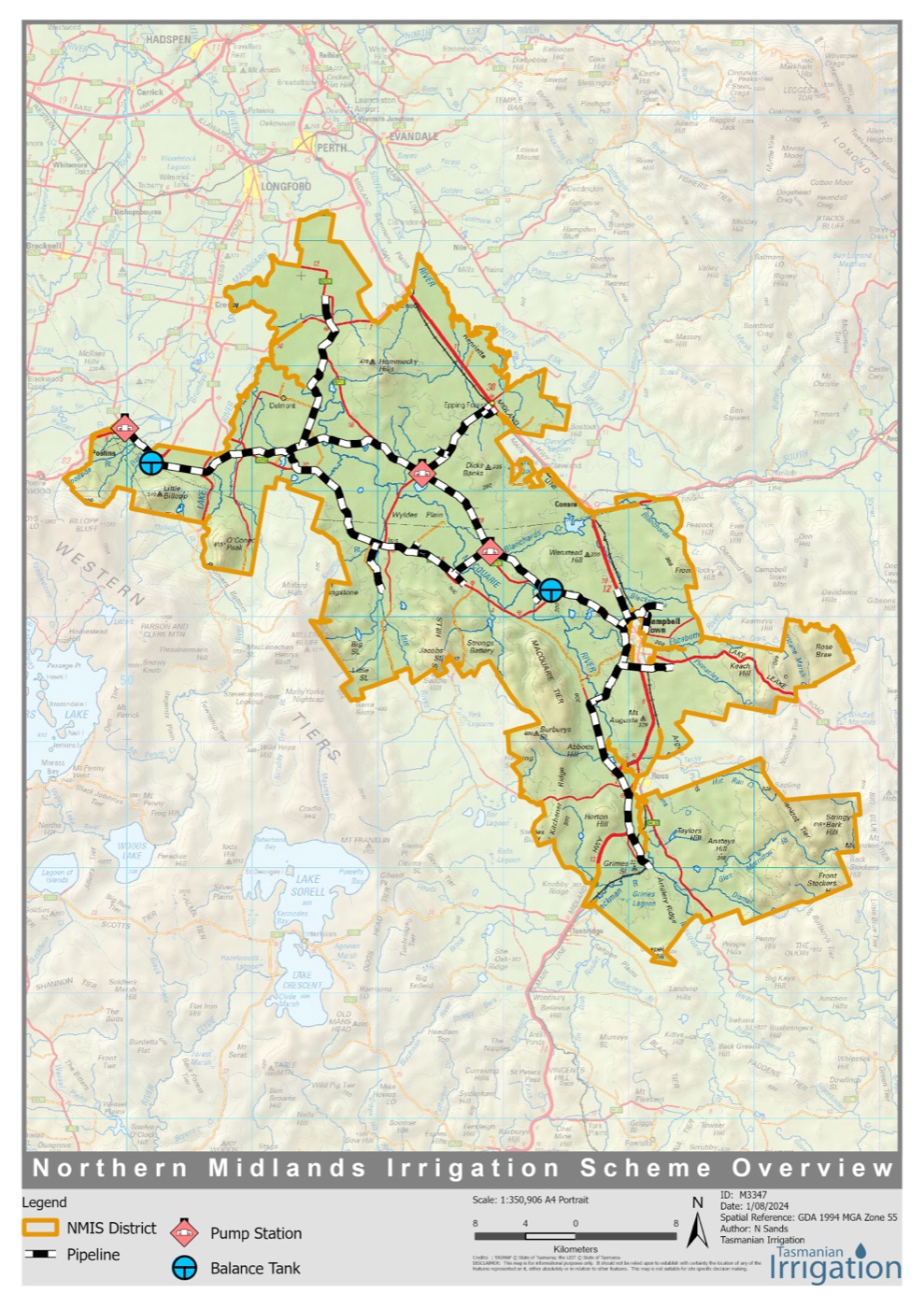
At Northern Midlands, customer demand resulted in increasing the planned capacity from 13,000 ML to 25,500 ML. Irrigators’ purchases of water entitlements provided evidence of that demand and contributed $36.72 million towards the capital cost of the project.
This connection between customer commitment and infrastructure planning matters to designers and suppliers. The volume farmers are prepared to purchase, the crops they intend to grow and when they need water all influence the system required to serve them.
Making hydropower releases work for irrigation
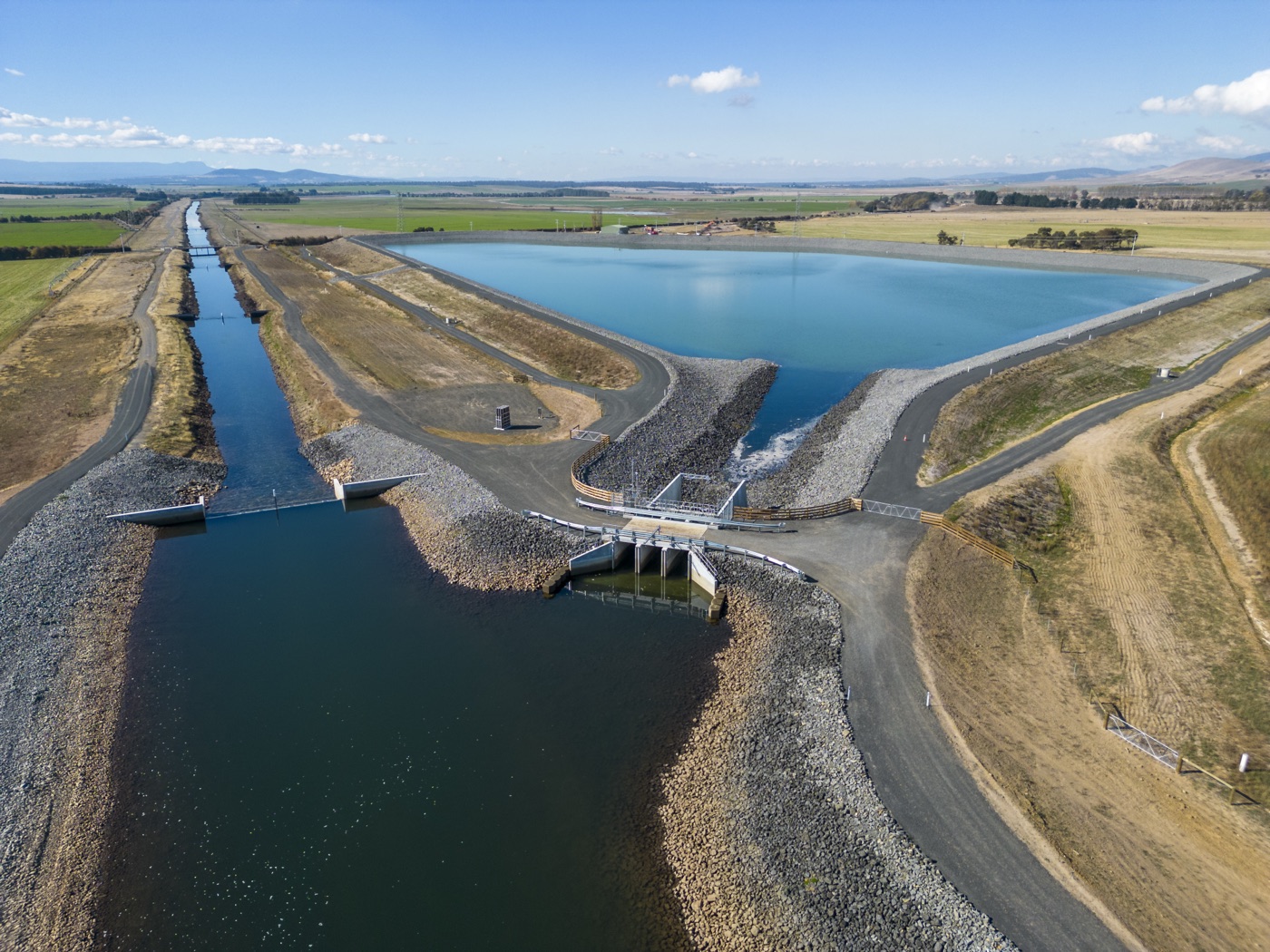
The Northern Midlands receives about 400 mm of rain a year, with variable rainfall and limited local water resources constraining production. The scheme draws on water from higher-rainfall catchments, underpinned by Hydro Tasmania’s central highland storages, after it passes through Poatina Power Station.
The engineering challenge was to turn variable hydropower discharges into a dependable irrigation supply. A purpose-designed drop structure diverts water from the Poatina tailrace into a 650 ML buffer dam via flow control gates. Under high-flow conditions, the dam can fill in less than 12 hours. The stored water sustains deliveries during periods of low or no discharge from the power station.
Water is pumped at up to 2,000 l/s to a balance tank at a high point and then flows by gravity through a ring-main network. A second balance tank and two boost pump stations help maintain pressure and extend supply across a district served by 152.4 km of underground pipeline. Farm outlets are monitored and controlled remotely, giving operators visibility of demand across the network.
The two large stainless-steel balance tanks were fabricated on site, a first for Tasmanian Irrigation. This avoided transporting completed tanks, while the design and material selection addressed environmental constraints and long-term maintenance considerations.
The scheme has a stated water surety of 95 per cent. Its 180-day irrigation season uses a delivery flow rate based on supplying the seasonal volume over 150 days, providing flexibility in when irrigators take their water. That distinction between seasonal entitlement and delivery capacity is important when planning an on-farm system.
Connecting water supply with farm planning
Every participating irrigator needs a Farm Water Access Plan before accessing scheme water. These property-specific plans identify land suitable for irrigation and set management requirements for soil, waterways, water quality and biodiversity. Tasmanian Irrigation reports that it audits 10–15 per cent of Farm Water Access Plans across its network each year.
For Northern Midlands, the plans have identified approximately 17,000 ha of previously unirrigated land as potentially suitable for irrigation. This provides scope to rotate irrigated crops across suitable paddocks over several years. It is not a statement that the scheme will irrigate all 17,000 ha in any one season.
Half of the scheme’s 50 participating landholders will be accessing Tasmanian Irrigation water for the first time. The production opportunities span livestock and field crops, including cereals, seed crops, poppies, potatoes and peas.
Environmental constraints also influenced the network itself. Geographic information system mapping informed pipeline alignments and construction planning. Narrower work corridors and trenchless crossings helped reduce disturbance to sensitive habitats and waterways. These decisions show how environmental information can shape the engineering solution from the outset.
The investment beyond construction
Tasmanian Irrigation reports that Northern Midlands supported more than 150 construction jobs. It forecasts that the scheme will support more than 450 direct and indirect jobs after completion and contribute an estimated $54 million annually to Tasmania’s economy. Those ongoing benefits are projections that depend on the farming activity and investment the scheme enables.
Across its schemes, the organisation estimates that each 1,000 ML of irrigation water delivered supports $2–3 million in on-farm infrastructure investment. The figure gives an indication of the work that can follow regional infrastructure: new irrigation systems, pumping and control equipment, as well as the services needed to install and maintain them.
Speaking ahead of commissioning, Tasmanian Irrigation chief executive Mike Sylvester described the intended outcome: “This scheme will give farmers greater confidence to manage seasonal risk, diversify production and invest in their businesses. Our product is water, but the problem we solve is water security.”
Reliable water is one part of that decision. Farmers also need viable crop markets, access to labour and processing, and operating costs they can manage. These factors will influence how quickly new capacity translates into production and regional employment.
Where irrigation expertise makes the difference
For Irrigation Australia members, Northern Midlands highlights the importance of the connection between the scheme outlet and the crop. A dependable regional supply creates an opportunity; the design and management of the farm system determine how effectively that opportunity is used.
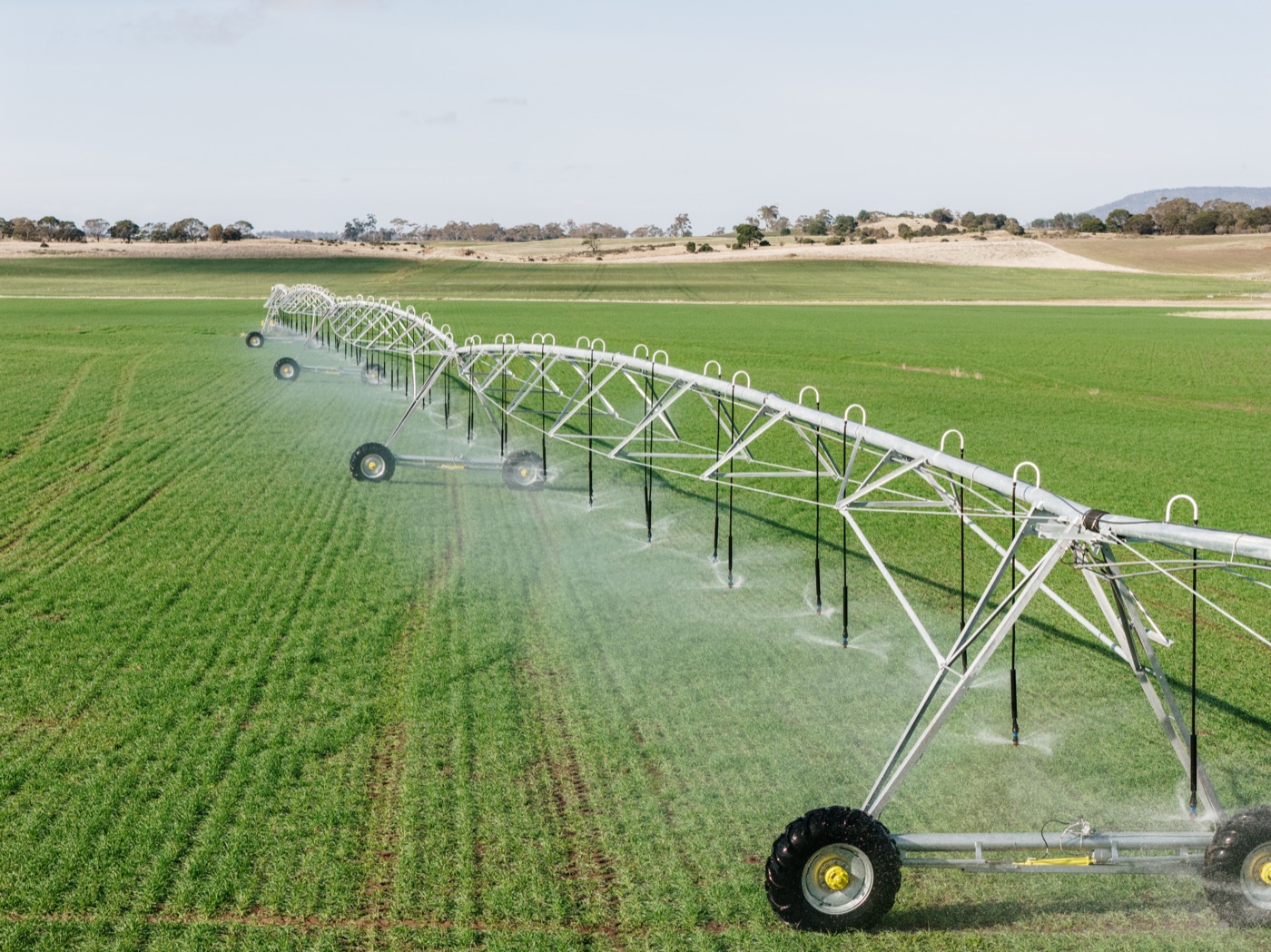
Designers and installers need to match available outlet flow and pressure with crop demand and the irrigation window. Suppliers can help customers assess equipment over its operating life, including energy and maintenance costs. Once systems are running, operators need the skills to interpret flow and pressure information, recognise faults and maintain performance.
Commissioning activity tested this connection by delivering water through the scheme network and property outlets to working on-farm irrigation equipment. For members involved in commissioning and handover, it is a useful example of checking that the complete delivery path performs as intended.
For families such as the Bennetts, the value of that work will emerge through the production choices and investment they can make over coming seasons. The irrigation industry’s contribution continues well beyond the arrival of the first water.
Back to listMore Reading
- 03-Nov-2026 How Reliable Irrigation Water Supports Investment in Tasmania New
- 23-Oct-2026 e-News Edition #75 New
- 07-Oct-2026 e-News Edition #74 New
- 30-Sep-2026 e-News Edition #73
- 10-Sep-2026 e-News Edition #72
- 28-Aug-2026 e-News Edition #71
- 14-Aug-2026 e-News Edition #70
- 04-Aug-2026 e-News Edition #69
- 03-Aug-2026 The Overflow Edition #84
- 23-Jul-2026 e-News Edition #68
- 08-Jul-2026 e-News Edition #67
- 26-Jun-2026 e-News Edition #66
- 12-Jun-2026 e-News Edition #65
- 28-May-2026 e-News Edition #64
- 08-May-2026 e-News Edition #63
- 10-Apr-2026 e-News Edition #62
- 26-Mar-2026 e-News Edition #61
- 26-Feb-2026 e-News Edition #60
- 10-Feb-2026 e-News Edition #59
- 15-Jan-2026 e-News Edition #58
- 12-Dec-2025 e-News Edition #57
- 20-Nov-2025 e-News Edition #56
- 06-Nov-2025 e-News Edition #55
- 16-Oct-2025 e-News Edition #54
- 02-Oct-2025 e-News Edition #53
- 18-Sep-2025 e-News Edition #52
- 04-Sep-2025 Certification Update #3 | September 2025
- 04-Sep-2025 e-News Edition #51
- 21-Aug-2025 e-News Edition #50
- 31-Jul-2025 e-News Edition #49
- 29-Jul-2025 Queensland Member Regional Update | July 2025
- 17-Jul-2025 e-News Edition #48
- 04-Jul-2025 Certification Update #2 | July 2025
- 03-Jul-2025 e-News Edition #47