

e-News Edition #57
Date: 12-Dec-2025
Hot Topics
1. Planning Your First Week Back: Reducing Work vs Life Anxiety
2. National Policy & Parliamentary Outlook
3. MDBA Basin Outlook: Future Hydroclimate of the Basin
4. The 450 GL Program: What the WESA Review and Independent Analysis Reveal
5. WA Government: Industry Innovation & Major Water Infrastructure Investment
6. Key Industry Events for Early 2026
7. Wrap Up 2025 with Training – Open 2026 with Opportunity
8. The Irrigation Australia Talent Hub – Employers Wanted!
9. End-of-Year Message
1. Planning Your First Week Back: Reducing Work vs Life Anxiety
For many of us, the holiday period is a chance to rest, reset and spend time with family. But for a sizeable portion of the Irrigation Industry, the reality is quite different. December and early January coincide with peak season, those hot temperatures, increased evapotranspiration rates, and heavy demand from customers across agriculture, nurseries, turf, parks and gardens, golf courses and sports fields, and all those other sectors we work with. Many workers take little actual time off because the work doesn’t stop - crops still need to be watered, turf still needs to survive the summer, and systems still need to run reliably.
This means the so-called “holiday break” can leave workers feeling more exhausted than refreshed, making the return to a full schedule in January feel overwhelming. Planning your first week back - before you go on leave - is one of the most effective ways to reduce this anxiety.
Understanding - Why January feels so hard and heavy
The holidays aren’t a break for everyone
Workers in the irrigation sector often juggle long hours, hot conditions and customer urgency right up until Christmas Eve. Add the financial pressure of the season, family demands and limited downtime, and it’s no surprise that many workers return in January feeling drained rather than recharged.
Recognising this is important. You’re not always coming back from a relaxing holiday – you can often feel as though you are coming back after a period just as demanding as any other month.
“We need it done before Christmas” simply becomes “Can you do it first week back?”
Customer demands rarely disappear. Jobs that couldn’t be completed before the break due to weather, supply delays or sheer workload become the first urgent tasks in the new year. Many teams walk into the office or workshop to find a backlog that feels bigger than when they left, plus all the new holiday projects that mount up.
Overworking in December creates a heavier January
The push to “get everything done before the break” often leads to fatigue, rushed decisions and tasks that need follow-up. The just get it done approach can create issues to be dealt with when you return, these corrections and carry-over jobs can make the first week back even more stressful.
Forward Planning to Make Your First Week Back Manageable
Build a realistic January priority list
Before finishing for the year, list the tasks that will definitely carry into January. Then sort them into:
- Safety-critical or high-risk work
- Customer-impacting work
- Low-risk or routine work
Decide what will not happen in Week 1 - and tell people early.
Many customers will accept realistic timelines when they’re communicated before the holiday shutdown. Clear expectations reduce unnecessary pressure on all of us.
Create a simple “first three days” plan
A predictable structure reduces anxiety:
- Day 1: Check emails, admin, safety checks, equipment checks and servicing
- Day 2: High-priority field tasks
- Day 3: Follow-ups and scheduling
Avoid the trap of trying to “catch up” immediately
You cannot - and should not - clear weeks of demand in four days. Overworking in those expected hot days increases fatigue, increases the likelihood of safety incidents, and develops burnout much sooner.
Check in with your team
Many people return carrying stress, fatigue or financial worry. A short team meeting in Week 1 helps identify workload pressures and reinforce safe work practices.
Final Thought
The irrigation workforce keeps landscapes alive, sustains crops, and manages water efficiency during the harshest part of the year - often with little genuine downtime. By acknowledging this reality and planning your first week back, you can reduce anxiety, improve safety and set yourself up for a more sustainable start to the year.
And don’t forget. Check in with yourself first.
2. National Policy & Parliamentary Outlook
As Parliament wrapped up its final sitting week of 2025, the political landscape shifted rapidly, with direct implications for water policy, Basin management and environmental reform heading into 2026.
The Coalition struggled to present a unified position during negotiations on the EPBC Act reforms, with reports of disorganisation, competing internal views and an unclear strategy. This culminated in former Nationals leader Barnaby Joyce resigning to sit as an Independent. The resulting fragmentation has created ongoing uncertainty around the Coalition’s ability to influence future water and environmental legislation.
In contrast, Minister Murray Watt delivered the Government’s EPBC reforms by the self-imposed deadline, reinforcing his growing profile as a strong performer in the environment and water portfolio. While this was a major legislative achievement for Labor, broader economic pressures, including cost-of-living concerns and slower progress on emissions reduction, and continue to draw scrutiny.
For the irrigation sector, two major reports were released this week: the Third WESA Review and the MDBA Basin Outlook. Although overshadowed by the politics of the final sitting week, both reports will play a critical role in shaping the policy environment for 2026.
More information or to see the full report
3. MDBA Basin Outlook: Future Hydroclimate of the Basin
Released on 27 November, the MDBA Basin Outlook provides an updated view of how the Basin’s climate and hydrology may evolve to 2050. The assessment points to a Basin that is becoming hotter, more variable and less predictable, placing increased pressure on system inflows, water availability and ecological outcomes.
Small changes in rainfall may lead to disproportionately large reductions in runoff, which impacts allocations, floodplain connection and environmental watering opportunities. The Outlook also highlights ecological risks, with fewer medium-to-high flow events affecting fish movement, wetland health and long-term system resilience.
These findings reinforce the importance of complementary measures, operational improvement and constraints management as part of future Basin Plan implementation.
Key takeaways
- The Basin is projected to become hotter, with more frequent extreme heat.
- Rainfall is expected to become more variable and harder to predict.
- Minor rainfall reductions may lead to significant declines in runoff.
- Allocation reliability and inflows may become increasingly volatile.
- Environmental outcomes may be constrained without operational reforms and complementary measures.
- Findings align with the National Climate Risk Assessment, confirming the scale of climate risk facing the Basin.
Download the full MDBA Basin Outlook
4. The 450 GL Program: What the WESA Review and Independent Analysis Reveal
Two major reports released this week, the Third WESA Review and a comprehensive independent analysis of the Additional HEW (450 GL) program. They Provide the clearest picture to date of the challenges, risks and limitations surrounding the 450 GL program. Together, they highlight significant funding shortfalls, delivery constraints, economic concerns and questions of environmental effectiveness.
Funding, Deliverability and Transparency Issues (WESA Review)
The Minister tabled the Third Independent Review of the Water for Environment Special Account (WESA), confirming substantial challenges:
- Current funding is insufficient to deliver the full 450 GL program.
- At least $1.3 billion in additional funding would be required to meet purchase targets.
- Only 35% of the 450 GL has been recovered to date, at an average cost of ~$5,040/ML (LTDLE).
- Constraints management remains significantly behind schedule, limiting the environmental utility of water already purchased.
- The Sustaining Basin Communities program has not yet produced measurable outputs, making outcomes impossible to assess.
- The review observed inconsistent reporting and limited transparency across program data sources.
This provides critical evidence base ahead of the 2026 Basin Plan Review.
Program Effectiveness, Environmental Outcomes & Value for Money (HEW Analysis)
A detailed independent assessment of the Government’s additional Held Environmental Water (HEW) acquisitions highlights broader challenges beyond funding alone.
1. The 450 GL is not required for SDL compliance
Only 62 GL is required under the SDL Adjustment Mechanism: a threshold that has already been exceeded.
2. Most purchased water cannot be delivered
- 65% of entitlements purchased to date face physical or operational delivery constraints.
- 75% of water offered through EOI1 would also be restricted.
- Without State and community-supported constraints reform, much of this water has limited Basin-scale benefit.
3. The program does not align with current environmental science
The MDBA’s 2025 Basin Plan Evaluation shows:
- Flow-based indicators are performing relatively well.
- Non-flow indicators (native fish, habitat condition, ecological processes) are performing poorly.
This suggests investment should prioritise:
- Complementary measures
- Constraints management
- Habitat and water quality improvements, rather than additional water purchases.
4. The program is not economical
- Total costs are trending toward $3 billion.
- Purchases require paying significant market premiums.
- The Commonwealth now represents a major share of entitlement demand in some markets.
- Achieving the full 450 GL would require acquiring volume equivalent to over 100% of annual market turnover — an impractical and inflationary task.
5. Socio-economic assessments remain incomplete
Data gaps and inconsistent modelling limit the ability to fully assess impacts, making compliance with the Water Act’s socio-economic obligations uncertain.
Overall Implications
Taken together, the WESA Review and HEW analysis reinforce a consistent conclusion: the 450 GL program faces significant financial, operational, environmental and socio-economic challenges that limit its effectiveness and value.
The independent analysis recommends pausing further HEW purchases until:
- An outcomes-focused review is completed, and
- The 2026 Basin Plan Review provides updated guidance.
Download the full WESA Review and HEW analysis
5. WA Government: Industry Innovation & Major Water Infrastructure Investment
The Cook Government has announced two major initiatives shaping Western Australia’s innovation, sustainability and water security agenda for 2026, signalling strong State focus on emerging industries and climate resilience.
2026 Innovative Industries of the Future Conference
This conference will bring together leaders in technology, sustainability and advanced manufacturing, highlighting:
- Low-carbon and clean-tech industry development
- Opportunities for agriculture and water-dependent sectors
- Climate resilience, digital capability and modernisation
- Collaboration between industry, research and regional communities
For irrigation businesses, this presents opportunities to engage with new technologies and potential innovation funding.
Record Investment in Water Infrastructure
The WA Government has also announced major investments across metropolitan and regional water infrastructure, one of the State’s most significant programs in recent years.
Key priorities include:
- Treatment and distribution network upgrades
- Expansion of recycling and groundwater replenishment projects
- Infrastructure improvements supporting agriculture and regional communities
- Planning for long-term diversification of water sources under a drying climate
These investments strengthen WA’s water security while creating opportunities for contractors, irrigation service providers and engineering firms.
6. Key Industry Events for Early 2026
Add these important sector events to your calendar:
XI International Symposium on Irrigation of Horticultural Crops
18–23 January 2026 | Tatura SmartFarm, Victoria A global symposium hosted by ISHS, Agriculture Victoria and the University of Melbourne, featuring keynotes, technical tours and workshops on the theme “Acting on water for climate change, environment and energy.”
International Conference on Water Management & Irrigation Technologies (ICWMITA-26)
16 January 2026 | Brisbane A research and industry forum exploring advances in agricultural water management and irrigation technologies.
2026 Perth Garden Show
17–19 April 2026 | McCallum Park, Perth Western Australia’s premier gardening expo featuring Waterwise/Fertilise-wise zones, irrigation demonstrations and sustainable landscaping showcases.
More information
7. Wrap up 2025 with training – Open 2026 with opportunity
As the year comes to an end, now is the perfect time to prepare for a more capable, confident and skilled workforce in 2026.
Our training programs continue to deliver practical, industry-focused skills that support long-term capability across the irrigation sector.
Training That Works for You
Our new online training platform, continues to receive outstanding feedback from learners who value:
- User-friendly navigation
- Simple, streamlined course structure
- Easy progress tracking throughout each program
Upcoming training
January:
February:
- Electrofusion and Butt Welding | South Australia, Adelaide | 19 - 20 February
- Certified Meter Installer and Validator | South Australia, Adelaide | 24 - 26 February
- Electrofusion and Butt Welding | Victoria, Melbourne | 26 - 27 February
March:
- AHC32424 Certificate III in Irrigation Technology | Queensland, Brisbane | 16 March 2026 - 15 March 2028
- AHC32424 Certificate III in Irrigation Technology | Western Australia, Perth | 9 March 2026 - 08 March 2028
- Irrigation Efficiency & Practical Skills | Virtual | 17 - 18 March
- Certified Meter Installer and Validator | Queensland, Brisbane | 24 - 26 March
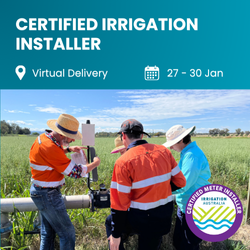
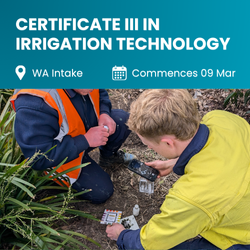
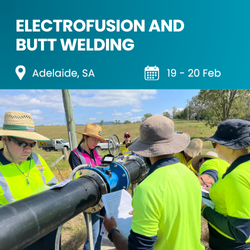
Click here to view all upcoming training
Help Shape Our 2026 Training Calendar
Our mission is to create opportunities for industry members. If there is a course or training area you would like to see in 2026, please email info@irrigation.org.au.
Upskill your workforce while saving on costs! Discounts are available for multiple staff enrolments from the same organisation.
Contact training@irrigation.org.au to discuss group bookings.
8. The Irrigation Australia Talent Hub – Employers Wanted!
Finding and keeping great people continues to be one of the biggest challenges across the irrigation industry.
That’s why Irrigation Australia, in partnership with Goheadhunt, has launched the Irrigation Talent Hub — a platform connecting employers with pre-screened, job-ready candidates from across Australia.
Why Join the Talent Hub
- Register your free employer profile
- Access a growing pool of industry talent
- Only pay if you hire – Pay-for-Success model
Featured talent now available:
- T.L. – Team Leader Irrigation | City of Belmont, WA – Full-time, 9-day fortnight, competitive salary.
- F.L. – Irrigation Technician | Perth, WA – Full-time role with Frenchams Landscaping Services, seeking experienced technician.
- B.R. – Reticulation Technician | Perth, WA – Full-time, hands-on field role with Beyond Reticulation.
- F.I.N. – Irrigation Channel Operator | Emerald, QLD – Full-time position with Fairbairn Irrigation Network, supporting regional water delivery.
- P.S.S. – Landscape Supervisor | Mandurah, WA – Full-time role with Peel Scape Solutions, leading projects across residential, commercial and local government.
- N.W.S. – Commercial Irrigation Serviceman | Perth Metro, WA – Full-time, service and maintenance role with Newground Water Services.
Irrigation Australia Members: Don’t miss out - set up your free profile today and access a growing pool of talent.
Join the Irrigation Talent Hub
9. End-of-Year Message
Thank you to our members, partners and industry colleagues for your continued support throughout 2025. This year has brought significant reform, important reviews and new challenges, but also opportunities for leadership, collaboration and industry improvement.
We look forward to working with you in 2026 to strengthen the capability, resilience and future direction of the irrigation sector.
Have a safe and restful Christmas and New Year.
Click here if you are interested in becoming an Irrigation Australia Member.
Click here to view upcoming Training Courses.
Click here to view the latest Career Opportunities available within the Irrigation Industry.
More Reading
- 07-Oct-2026 e-News Edition #74 New
- 30-Sep-2026 e-News Edition #73 New
- 10-Sep-2026 e-News Edition #72
- 28-Aug-2026 e-News Edition #71
- 14-Aug-2026 e-News Edition #70
- 04-Aug-2026 e-News Edition #69
- 03-Aug-2026 The Overflow Edition #84
- 23-Jul-2026 e-News Edition #68
- 08-Jul-2026 e-News Edition #67
- 26-Jun-2026 e-News Edition #66
- 12-Jun-2026 e-News Edition #65
- 28-May-2026 e-News Edition #64
- 08-May-2026 e-News Edition #63
- 10-Apr-2026 e-News Edition #62
- 26-Mar-2026 e-News Edition #61
- 26-Feb-2026 e-News Edition #60
- 10-Feb-2026 e-News Edition #59
- 15-Jan-2026 e-News Edition #58
- 12-Dec-2025 e-News Edition #57
- 20-Nov-2025 e-News Edition #56
- 06-Nov-2025 e-News Edition #55
- 16-Oct-2025 e-News Edition #54
- 02-Oct-2025 e-News Edition #53
- 18-Sep-2025 e-News Edition #52
- 04-Sep-2025 Certification Update #3 | September 2025
- 04-Sep-2025 e-News Edition #51
- 21-Aug-2025 e-News Edition #50
- 31-Jul-2025 e-News Edition #49
- 29-Jul-2025 Queensland Member Regional Update | July 2025
- 17-Jul-2025 e-News Edition #48
- 04-Jul-2025 Certification Update #2 | July 2025
- 03-Jul-2025 e-News Edition #47
- 19-Jun-2025 e-News Edition #46